
Orange Township Previous Residents by Era
Previous-resident research in Orange Township works best as a layered timeline. Land instruments supply an ownership chain, then directories and released census schedules add dated household clues. Printed sources, maps, notices, and probate files help close gaps, but they do not all cover the same years or identify the same people. Start with the source closest to the period in question and keep its limit beside the result.
| Source | Years It Covers | Where Held | What It Shows |
|---|---|---|---|
| Recorder real-estate web index | 1990-present | Recorder public search / PaxWorld | Party, instrument, book/page, and tract chain; not every later document is computerized |
| Recorder original books and exam room | Before 1990 and online exceptions | Delaware County Recorder, 145 N. Union Street | Older instruments and index routes with staff guidance |
| Mendenhall Files | 1800-1891 | Cryder Research Library | Property-transfer research lead to reconcile with original deeds |
| Digital city directories | 1859-1922, eleven editions | Ohio Memory / Historical Society | Dated local and county household snapshots, not annual or Orange Township-only |
| Library and rural-route directories | Exact shelf years not published online | DCDL Local History Room and Cryder | Address and route clues after an in-person inventory |
| Delaware Gazette microfilm | 1821 to today | DCDL Local History Room | Notices, obituaries, addresses, and local social or property context |
| Federal census | Released after 72 years | DCDL and Census or genealogy channels | Household at a census date, not a modern address record |
| GIS historic aerial imagery | 1997-present | Delaware County Auditor GIS | Physical development context, not an occupant or title record |
For a recent Orange Township trail, start with the parcel and Recorder index. For an earlier address, take the legal description to the Recorder exam room, then use the Mendenhall Files, directories, Gazette, maps, and released census records as complementary evidence.
Orange Township's 1990 Records Cutover
The Recorder's stated web boundary is 1990 to present for real-estate documents. That does not make the web index complete even for later years: the Recorder warns that not every post-1990 document is computerized and that image start dates differ by document type. Data refreshes about every five minutes. A no-result screen can therefore point to an office search, a spelling variation, or a different search route, not the end of an Orange Township deed trail.
The Recorder's PaxWorld index is the online channel for name, instrument, book/page, and legal filters.
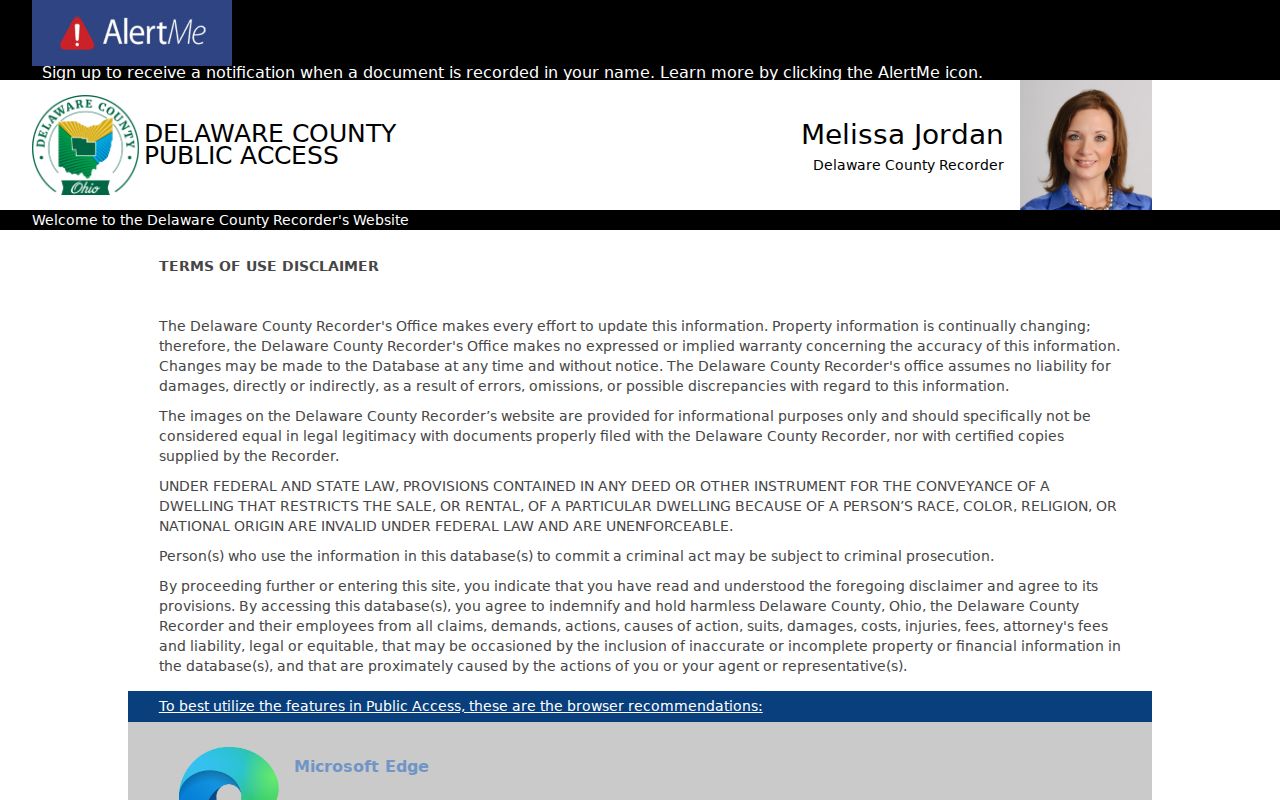
The index is most useful after an Orange Township parcel record supplies a current owner, transfer date, legal description, or prior instrument reference.
For Orange Township records before 1990, and whenever an instrument or image is missing online, the real access channel is the Recorder exam room at 145 N. Union Street in Delaware. The office records and exam room are open Monday through Friday, excluding holidays, from 8:30 a.m. to 4:30 p.m.; document submission ends at 4:00 p.m. A narrow request can also be routed to the custodian under Ohio's Public Records Act, R.C. 149.43.
Trace the Delaware County Deed Chain
An Orange Township deed chain starts with the Auditor or GIS parcel record, not with an address search in the Recorder index. Preserve the parcel number, present owner, situs address, legal description, and latest conveyance date. The Recorder is organized as a forward-and-reverse tract index. A party's name, book/page, or instrument number opens the next record; the legal description links the records to the same land even when street numbers or postal labels change.
- Find the present Orange Township parcel by address, owner name, or parcel number in the Auditor's property search or GIS.
- Record the current owner, legal description, parcel, and last conveyance date before leaving the property record.
- Search that current owner as the grantee in the Recorder index around the conveyance date and inspect the acquisition deed.
- Write down the seller, or grantor, plus the instrument number, book/page, document type, recording date, and legal description.
- Search that seller as a prior grantee against the same tract or legal description, then repeat the sequence backward.
- Move to original books and the exam room at the 1990 cutoff or when the web result lacks a needed image or index entry.
- Grantor
- The party conveying an interest in an instrument, commonly the seller in a deed.
- Grantee
- The party receiving an interest, commonly the buyer in a deed.
- Chain of title
- The linked sequence of recorded conveyances for the same tract or legal description.
- Legal description
- The recorded land description, such as a lot, subdivision, or metes-and-bounds description, used to connect older Orange Township records more reliably than a current street number.
Orange Township Address Continuity
Orange Township's postal geography creates a real continuity trap. Land may be described with Lewis Center, Powell, Westerville, Delaware, or Columbus-style labels, while county GIS separately maps ZIP Code, Township, Municipality, Annexation, Address Point, Street Centerline, Subdivision, and Parcel layers. When an older address appears not to match a current one, compare its tract, plat, lot, rural route, and nearby roads before discarding it.
No official township source located a dated townshipwide street-renumbering ordinance. A reliable Orange Township search should not invent one. Use the legal description, recorded subdivision or survey plat, an old map, and the Recorder chain to bridge an address difference instead.
Note: A mailing-city label identifies postal handling, while the parcel layers identify the geographic jurisdiction needed for an Orange Township record search.
Orange Township Mendenhall File Bridge
Cryder Research Library's Mendenhall Files cover Delaware County property transfers from 1800 through 1891. That range gives Orange Township research a valuable early lead, especially where the web deed index begins too late. It is not a substitute for the original deed chain. Use the file to identify a transfer or owner lead, then compare the original Recorder instrument, tract, legal description, and date before treating the connection as established.
The local contrast is important: the Recorder web index begins in 1990, while Mendenhall reaches 1800-1891. The middle and older portions still require Recorder books, the exam room, and other historical sources. Cryder also supplies maps, atlases, obituaries, rural-route directories, newspapers, and clipping files that can test a dated Orange Township property trail.
Note: A Mendenhall transfer is a local research lead, while the original Recorder instrument remains the record to inspect for the actual chain.
Orange Township Past Household Trail
Ownership is only one layer in a search for Orange Township previous residents. County and city directories, rural-route volumes, newspaper notices, and a released federal census can add household evidence for a specific date. The Historical Society's eleven digitized directories cover 1859-1922 but are not an unbroken annual sequence, and DCDL and Cryder have additional shelf collections with unpublished online year ranges. The volumes themselves are described in the Orange Township Directory Book.
Use the household sources in order of date, not as a single merged roster:
- Choose a directory edition close to the deed transfer or an address clue and copy the entry exactly.
- Check the next available edition, a rural-route directory, or local shelf inventory instead of assuming a missing annual volume.
- Search the Gazette microfilm or the digitized 1902-1929 Journal-Herald collection for a date-specific notice, obituary, or property reference.
- Pair the period with the nearest federal census that has passed the 72-year release rule.
- Compare the household clue with the parcel's legal description and deed dates before placing it at the Orange Township address.
A directory or census entry can support a household at its own date. It should not be used to infer a living person's current location or to fill gaps the record does not cover.
Orange Township House-History Limits
Sanborn Fire Insurance Maps and Historic Map Works are available through DCDL's Local History and Genealogy resources, but the research did not locate a verified Orange Township-specific Sanborn year list. Consult the library's place search or staff rather than assigning dates that have not been documented. Maps and Auditor GIS historic aerial imagery can help date a visible building change or land-use context. They do not identify a resident, establish title, or replace a recorded survey.
Orange Township zoning and county permit files can add a project, applicant, or construction clue when requested for a specific address and date range. The research did not locate a separately titled township house-history service. The documented route is DCDL Local History, Cryder, the Recorder exam room, and county GIS plat or survey tools.
Lawful house-history use. Orange Township previous-resident research is appropriate for family history, estate questions, and personal property history. Do not use a dated record to track, harass, or endanger any living person.
Orange Township Previous Resident Endpoints
Obituaries and probate records often provide the final dated clues in an Orange Township trail. Cryder lists Delaware County obituary archives, while the Probate Court has estate records from January 20, 1950 to the present subject to its access limits and older or different records can be off-site. An estate record may identify a decedent, fiduciary, or next of kin; an obituary can suggest a final locality or relationship. Each lead needs verification in the original probate or other official record.
Marriage records also have a local split: Probate holds 1996-present records, while earlier Delaware County marriage records are at the Records Center. This is a useful date-aware access route, not a shortcut for proving where a person lived. For material outside a portal, contact the office that keeps it or submit a focused R.C. 149.43 request.
Orange Township Recorder AlertMe Notices
Recorder AlertMe is a future-monitoring tool, not an archive of Orange Township previous residents. It alerts a registered name when a later recorded document matches after enrollment. It does not adjudicate fraud, prevent recording, or provide retroactive protection for documents that were recorded before the enrollment date. Former Property Check users were migrated when the Recorder changed the service in 2024.
The Recorder's property-fraud resource explains the current AlertMe pathway.
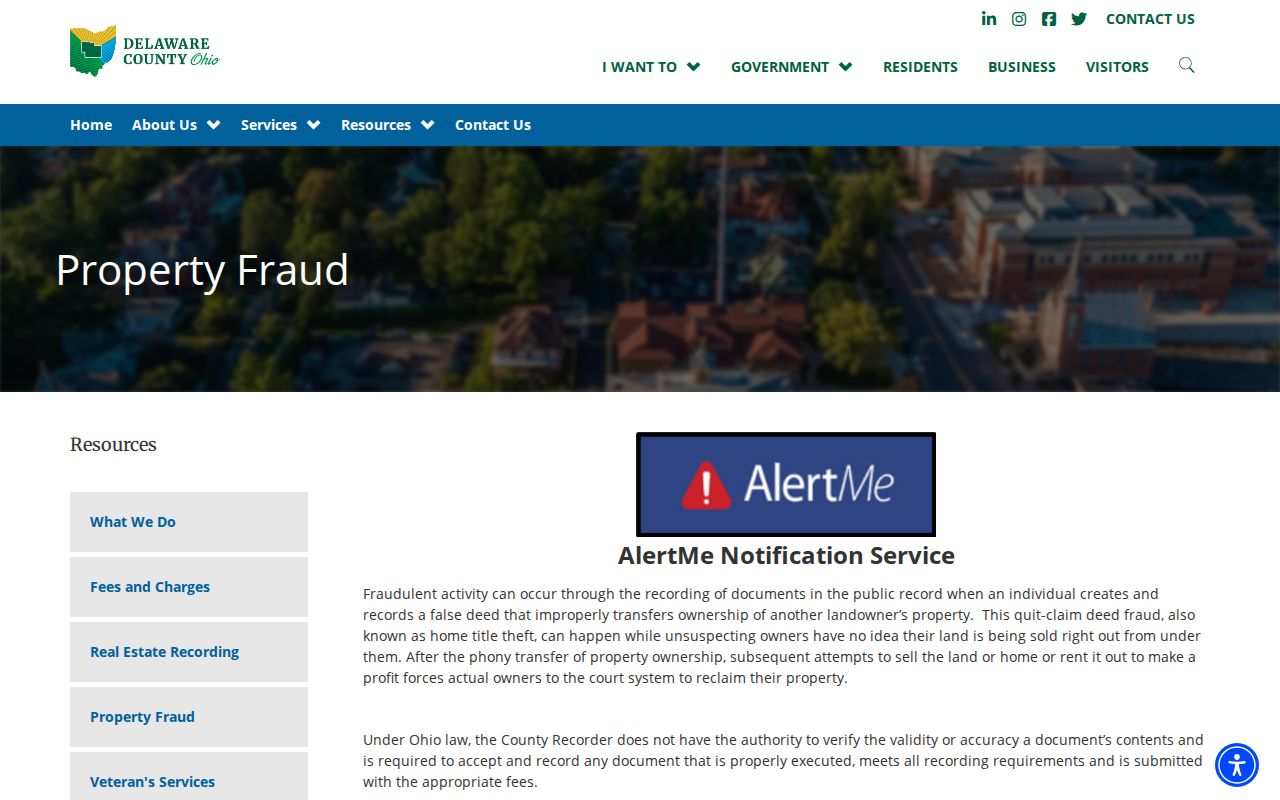
AlertMe can help an owner watch later Recorder activity, while a historical Orange Township deed chain still requires the index, original documents, and date-aware research.
Note: AlertMe begins watching only after enrollment, so it cannot add retroactive coverage to an Orange Township historical search.